Showing posts with label sports injuries. Show all posts

Tuesday, July 21, 2015

Back on Track: Helping Injured Athletes Regain Physical Vigor

Injuries are constant risks for athletes of every sport. Whether in basketball, gridiron, dirt track racing, or even fishing, the threat of a physical catastrophe looms at varying levels. At the worst case, players are left without choice but to prematurely end their careers and spend the rest of their lives in frustration. Fortunately, physiatrists come to the aid of athletes in accomplishing peak injury-free form.

http://www.bencks.com/wp-content/uploads/2013/01/bencks-photography-athletes-wes-03.jpg
Image source: bencks.com
Physiatrists work diligently to help injured players bring back the bliss and energy in their life following a massive accident or a dreaded disease that left them bedridden, immobile, or disabled. Through a range of customized programs, proven treatments, and physical exercises, physicians restore a certain percentage of the patient’s original physical state. The process is not easy and requires significant patience, determination, and a positive mindset. There have been cases of players fully recovering after religiously following their physiatrists’ advice.

Sports medicine, a sub-specialty of physiatry, is a dynamic and holistic approach to bringing back the body to full function. It focuses on the performance needs of athletes and the prevention of sports-related injuries. It applies to all types of sportsmen: professional, amateur, recreational or scholastic.

http://i.telegraph.co.uk/multimedia/archive/02290/adlington_2290687b.jpg
Image source: telegraph.co.uk
When athletes regain their physical might, they are more determined to recommence their careers and emerge triumphant. They rebuild their self-esteem, create new realities, and improve their overall relationship with other people. The tragic history of injuries serves as cautionary tale that helps athletes become more conscientious of their actions and more strategic in their competitive approach.

Dr. Mary Kneiser is an expert in treating and assessing physical injuries through different technologies such as Electromyography (EMG). For more about her specialization, visit this website.


Thursday, March 27, 2014

REPOST: Rise of sport science cannot hold back sands of time for footballers

How do medicine and sports science influence a footballer’s form and performance? Sean Ingle of The Guardian investigates.
Image Source: www.theguardian.com

It was a week for football's golden oldies. Samuel Eto'o, at 33, deftly opening the door against Galatasaray and Arsenal and Ryan Giggs, at 40, adding calm and class to Manchester United's engine room against Olympiakos. Arsène Wenger, at 64, chalked up his 1,000th Arsenal game in a daytime "nightmare" at Stamford Bridge.

Amid the eulogies for Wenger, John Hartson spoke of his methods "putting another two or three years" on the careers of Tony Adams, Lee Dixon and Ian Wright. Few would dispute that. In the past decade, those methods have become football's methods. Players are fitter. They recover from training with finely tuned protein-carb shakes, ice baths and massage; not a swift one-two at the pub.

We have come a long way from the days when footballers regarded broccoli as that guy who produced the Bond movies, and only did a downward dog when they slid off a bar stool.

Last year Sir Alex Ferguson said that "sport science is the biggest and most important change in my lifetime". Manchester United monitor 29 variables that may increase a player's susceptibility to injury; sometimes players will be pulled out just before training because something in their data isn't right.

Given such widespread advances, you might expect the average age of players in Europe's top leagues to be climbing sharply. It is not. The Football Observatory recently compared the average age by position of players in the Premier League, Serie A, La Liga, Bundesliga and Ligue 1 from 2005-06 to 2013-14 and found it was also static.

The average age of a first-team defender in the big five European leagues in 2005-06 was 26.21 years; now it is 26.35 – an increase of 0.14 years. The figures for goalkeepers, midfielders and attackers have barely changed either.

Meanwhile in the Premier League, Prozone's data for the 2011-12 and 2012-13 seasons shows that full-backs 33 or over played just 2.0% of all minutes played by full-backs. For wide midfielders that figure was 2.7%; strikers 3.6% and central midfielders 4.9%. For central defenders – whose positioning can sometimes negate a lack of pace – it was higher at 10.1%.

Image Source: www.theguardian.com

So what is happening? Two things. Sports science is helping older players to stave off the effects of ageing. But, at the same time, the physical demands on footballers is far greater too. So the status quo prevails. Once footballers hit their early thirties they are on borrowed time. Just like they always were.

What is striking, though, is how much faster football has become in the past decade. TV commentators in the 1970s and 1980s were fond of talking about matches being played at 100-miles-an-hour. It was a Sunday morning pootle compared to today's game.

Image Source: www.theguardian.com 


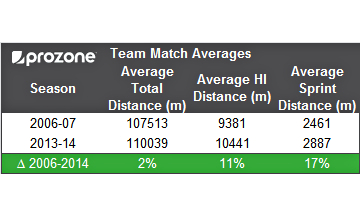
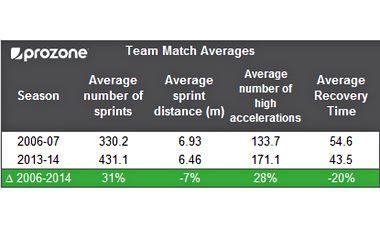
In 2006-07 the average number of sprints per team in a Premier League match was 330.2. This season Prozone's data show that it is 431.1, a 30.6% increase. Meanwhile recovery time between high intensity sprints (speeds of greater than 5.5 metres per second) has dropped from 54.6 seconds to 43.5 seconds, a decline of 20%. 

Image Source: www.theguardian.com 


Perhaps it is not surprising there are so few full-backs, wide midfielders and forwards over 33. They play in positions where a dip in pace is more likely to affect performance. It is not only in road safety adverts where speed kills.

Another development is that clubs monitor GPS and heart-rate data in training. They usually know when a player is 'gone' before we do.

The growth in post- and pre-season tours may also be a factor. Players have less down time to recover in the off-season – so recovery time, which becomes more important with age, can be scarce.

Of course the rate of decline will vary. Genetics, lifestyle, injury history and the number of games can all be a factor. But players are battling against age earlier than is often assumed. Maximal aerobic capacity – or V02 max – peaks around 18 to 20 and while it can plateau until 25 it tends to then decrease by approximately 8-10% per decade.

Dr James Carter, the head of the Gatorade Sport Science Institute at Loughborough University, says that vigorous training after the age of 25 can limit that decline to around 5% per decade but "significant reductions in physiological and performance-related capabilities will be more pronounced once a player enters their thirties".

With some players physiology is not everything. Even in his final season, Paul Scholes's passing figures were as good as ever. Others make themselves relevant in fresh ways. When Giggs still possessed the acceleration of a Maserati and the hips of a ballroom dancer, the ball was lover to nuzzle on those jinking, parabola-like runs; now it is more of a passing acquaintance.

But as a general rule, improvements in sport science and medicine have benefitted younger players as much as older ones. And so veterans are better retained at a similar rate than they were a decade ago. As Carter reminds us, "extending the shelf life of footballers beyond 35, in most cases, is still beyond the remit of science, technology and best practice".

When Giggs and Eto'o started out, football was considered a young man's game. Despite their notable achievements in the past week it still generally is.
Dr. Mary Kneiser’s nearly 20 years of experience in physical medicine and rehabilitation is decorated with various awards and recognition for her skill and expertise in patient care. Get a glimpse of her highly respected practice by visiting this blog.

Tuesday, October 8, 2013

REPOST: What Kids Should Know About Spinal Injuries in Sports

Laura Landro discusses efforts to raise awareness of a little-understood but dangerous risk to young athletes: injuries to the cervical spine which can lead to paralysis or even death. More from this Wall Street Journal article.

There is a new push to alert high school athletes about neck injuries.
(Image source: wsj.com)

It could be a hard tackle in football, a cross-check in ice hockey or a fall off the top of a cheerleading pyramid.
A new push is under way to raise awareness of a little-understood but dangerous risk to young athletes: injuries to the cervical spine, the highly vulnerable area between the first and seventh vertebrae that protects the spinal cord connecting the brain to the body. Players and teammates may not instantly recognize the severity of the damage, and the wrong move can damage or sever the spinal cord, resulting in paralysis or even death.

In addition to programs to educate coaches, parents and students, a number of groups are pressing for more certified athletic trainers who are qualified to quickly recognize and respond to spinal and other injuries.

Though less common than concussions, cervical-spine injuries most often occur when players in contact sports lower their head or tuck their chin into their chest and collide with another player, the ground or objects such as goal posts. While players often recover from injuries such as fractures of one or more vertebrae, commonly referred to as a broken neck, cervical spine injuries can also be quickly fatal.

De'Antre Turman, a 16-year-old Atlanta-area high school football player, died in August after being injured during a scrimmage, suffering a fracture to his third vertebra on the field, Fulton County Medical Examiner investigator Mark Guilbeau said in a telephone interview.

San Diego-based Athletes Saving Athletes co-founder Tommy Mallon, kneeling, conducts a demonstration with volunteer Danny Kolts during a 2012 seminar.
(Image source: wsj.com)

The Centers for Disease Control and Prevention estimate as many as 20,000 spinal-cord injuries occur annually in the U.S., with sports accounting for about 12%, and new cases most often occurring in 15-to-35-year-olds.

Robert Cantu, chief of neurosurgery at Emerson Hospital in Concord, Mass., and medical director of the National Center for Catastrophic Sports Injury Research at the University of North Carolina at Chapel Hill, says new rules put in place in 1976 to discourage headfirst contact in football—known as "spearing"—aren't consistently followed.

The number of reported cervical-spine injuries that lead to permanent or temporary neurological damage, such as partial or complete paralysis, remains small but appears to be on the rise. The center's Annual Survey of Catastrophic Football Injuries in high school and college last year found that in four of the previous 10 years, the number of such injuries that led to some paralysis was in the double digits—14 in 2008, for example—after dropping into the single digits throughout the 1990s. Many severe spinal-cord injuries in sports also go unreported, Dr. Cantu says.

Coaches who were surveyed told the researchers that they teach players to tackle with the head up, but many players still lower their heads before making contact and many ball carriers are injured with their heads down.

"There is a sense of invulnerability in young athletes who think it's not going to happen to them," says Ron Courson, director of sports medicine at the University of Georgia. In addition to training players on proper blocking and tackling techniques, his team practices injury response scenarios on the field with trainers, physicians and emergency responders before football season begins.

At Penn-Trafford High School in Harrison City, Pa., there are three athletic trainers on staff for the 1,600 athletes in grades 9 to 12, says Larry Cooper, head athletic trainer. Parents can attend classes for coaches about injury risks and a sports emergency action plan is available on the school's website.

While college athletic programs nearly always have athletic trainers on staff, the National Athletic Trainers' Association says only two-thirds of U.S. secondary schools with athletic programs have access to full- or part-time athletic trainers, who are typically licensed by the state and work under the direction of physicians. That's up from 40% to 45% in 2005, but leaves a third of schools without one, the nonprofit association says. The group is conducting a state-by-state ranking of public schools and a similar study on private schools to determine why schools don't have trainers. (Expense is one factor.) The group also is analyzing the medical care available at games when an athletic trainer isn't present.

Athletes Saving Athletes graduate Tucker Boucher, left, with fellow San Diego-area student-athletes. ASA focuses on sports safety education and injury prevention.
(Image source: wsj.com)

"Parents who would never leave their kids off at a public swimming pool without a lifeguard think nothing about dropping them off at football or soccer without an athletic trainer. But they need to ask who is taking care of their kids when they are participating in these sports," says Jim Thornton, president of the athletic trainer association and director of sports medicine and athletic training at Clarion University in Clarion, Pa.

The association issued recommendations for management of cervical-spine injuries in athletes in 2009 which include special care in removing a helmet, face mask and shoulder pads and immobilization techniques on the field. Erik Swartz, an athletic trainer and associate professor at the University of New Hampshire who co-wrote the recommendations, says one of the highest risks in a spine injury is moving an athlete.

Tommy Mallon, now 22, collided with another player during a lacrosse game in 2009 at Santa Fe Christian high school in Solana Beach, Calif. A teammate ran to his side but fortunately didn't attempt to help him up until athletic trainer Riki Kirchhoff got to the scene. She kept Mr. Mallon on the ground until emergency medical responders arrived.

At the hospital, he was diagnosed with a fracture in his spine at the C1 vertebra and a damaged artery restricting blood flow to the brain. After months of grueling rehabilitation, including traction in a massive "halo" device to immobilize his head and neck and physical therapy, he was able to start classes at the University of San Diego in the spring of 2010. Though he won't be able to play contact sports again, he sustained no permanent neurological damage.

Mr. Mallon and his mother, Beth Mallon, a photographer who was at the game when his injury occurred, formed a nonprofit group, Advocates for Injured Athletes, to help other families navigate the challenges of injuries and lobby for certified athletic trainers at every high school.

Last year the Mallons also launched Athletes Saving Athletes, a program which offers classes taught by athletic trainers to help student-athletes understand signs and symptoms of different types of sports injuries and conditions. About 1,500 athletes in the San Diego area have participated and Ms. Mallon aims to expand the program. "We can educate athletes to recognize basic symptoms, and if they suspect a neck injury, don't move them. Don't touch them. Just stay with them until help arrives," she says.

Tucker Boucher, 16-year-old junior at Cathedral Catholic High School in San Diego, says after going through the program, he talked to his lacrosse team about risks and how to recognize symptoms of injury. His mother, Annie Boucher, who also attended a session, says the training "empowers these kids with knowledge of certain situations that can save somebody's life."

Dr. Mary Kneiser works with athletes as they regain their strength and form after suffering an injury. Learn more how physiatrists help injured athletes get back on their feet on this Facebook page.